

THE POSITION FROM WHICH WE CANNOT SEE
An artist spends years developing a language. They learn to recognize the forms that belong to them, defend the decisions that distinguish their work, and give their practice a legible shape. When this process succeeds, something ambiguous happens: the language becomes recognizable to its maker, too. Before beginning a new piece, the artist already knows which decisions will appear consistent with their trajectory. They may even anticipate how the work will be interpreted.
This familiarity is an achievement. It can also become a constraint.
Artistic culture often assigns an almost moral value to total immersion: being an artist at all times, with no separation between life, sensibility, and production. Yet someone who remains inside a position indefinitely comes to know its interior better than anything else. They may no longer see the conditions that sustain it, or the alternatives it rules out.
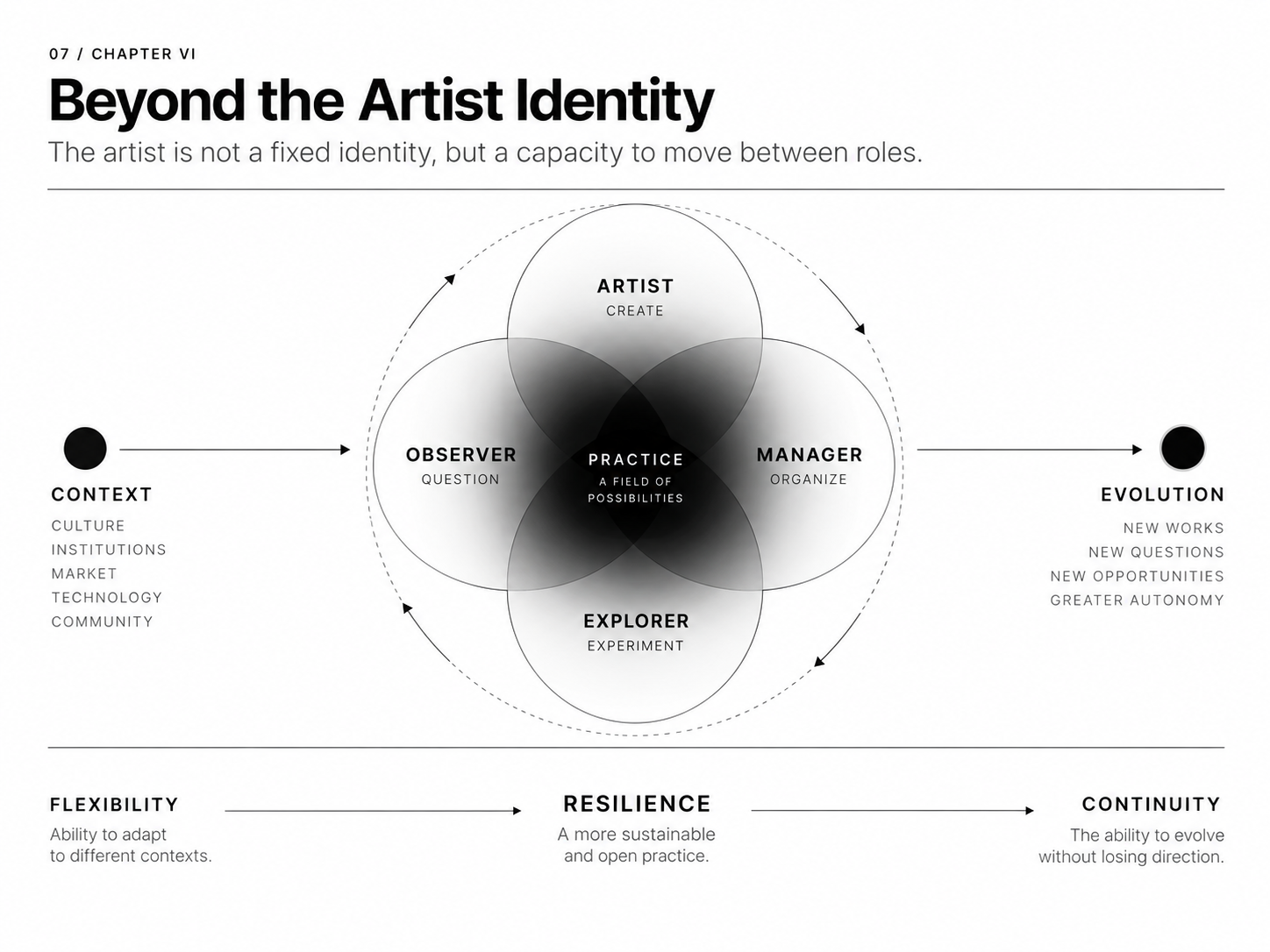
This suggests a counterintuitive possibility. At certain moments, understanding one’s work may require suspending precisely what defines one as an artist. Not abandoning the practice, but questioning the assumption that the author’s identity provides the best vantage point from which to judge it. Is such a suspension possible? And if so, what position might the artist occupy instead?
CORE · Members
Continue reading
This essay is part of CORE. Membership opens it in full, with every CORE essay, the Hypercast library and the Fakewhale AI Curator.