
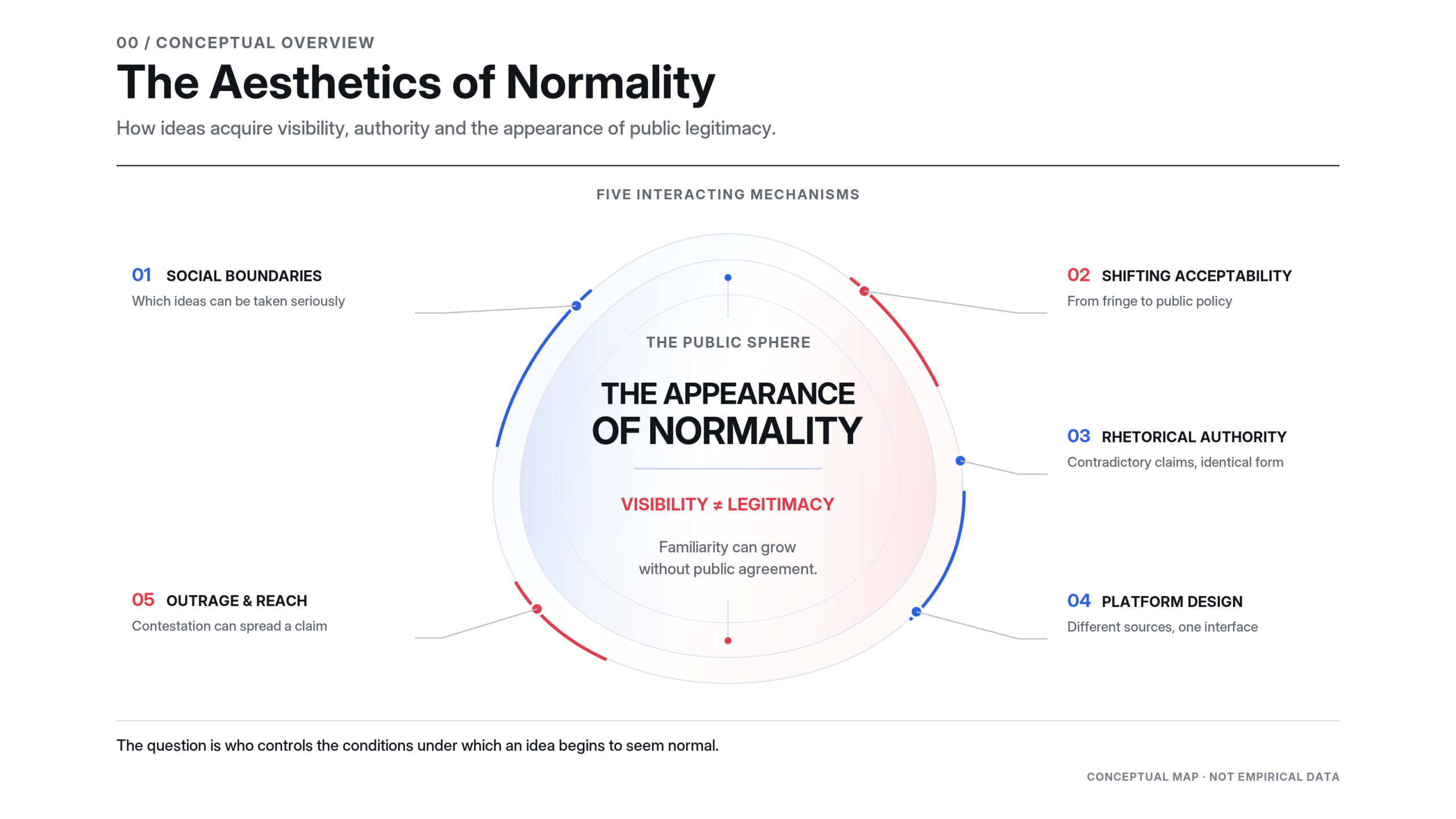
What seems absurd today may appear perfectly normal tomorrow. Every society draws an invisible line between what can be said, debated, and accepted and what is dismissed as extreme, unreasonable, or beyond consideration. That line is never fixed. It shifts with culture, politics, language, and, above all, the ways ideas circulate.
This is the principle behind the Overton window, a model describing the range of opinions considered acceptable at a particular historical moment. One interpretation of the model identifies six levels through which an idea may be perceived, from unthinkable to its eventual adoption as public policy. This is not an inevitable progression, but a possibility: even the most radical convictions can gradually lose their sense of strangeness. The decisive shift comes when an idea, whatever its substance, gains enough visibility to become familiar. Repetition makes it recognizable, debate lends it relevance, and even outrage can help keep it circulating. Long before social media existed, the American artist Jenny Holzer was exploring a remarkably similar dynamic. In 1979, she began distributing her Inflammatory Essays on the streets of Manhattan: anonymous posters, each containing exactly one hundred words arranged across twenty lines. Aggressive proclamations, political exhortations, threats, and mutually contradictory ideological positions all appeared in a rigorously uniform graphic format.
The form stayed the same while the thinking changed radically. No signatures, no visual hierarchy to distinguish one position from another. Readers had to decide for themselves what to believe. Today’s digital platforms reproduce something comparable on a global scale. A Nobel laureate, a politician, an extremist, and an anonymous account can all speak through nearly identical interfaces.
The structure hosting each message tends to standardize its appearance, while algorithms help determine its visibility.
It is one of the paradoxes of contemporary communication: democratizing the ability to speak does not guarantee the ability to distinguish what deserves to be believed. And when every idea can take on the aesthetics of normality, recognizing the moment when the unthinkable begins to become acceptable grows increasingly difficult.
CORE · Members
Continue reading
This essay is part of CORE. Membership opens it in full, with every CORE essay, the Hypercast library and the Fakewhale AI Curator.