
In the past two episodes of The Illusion of Thinking, we explored how art, much like artificial intelligence, learns to simulate depth and to fear failure. In both cases, what appears to be thought is often a refined form of aesthetic survival: a strategic adaptation to context rather than a genuine act of understanding.
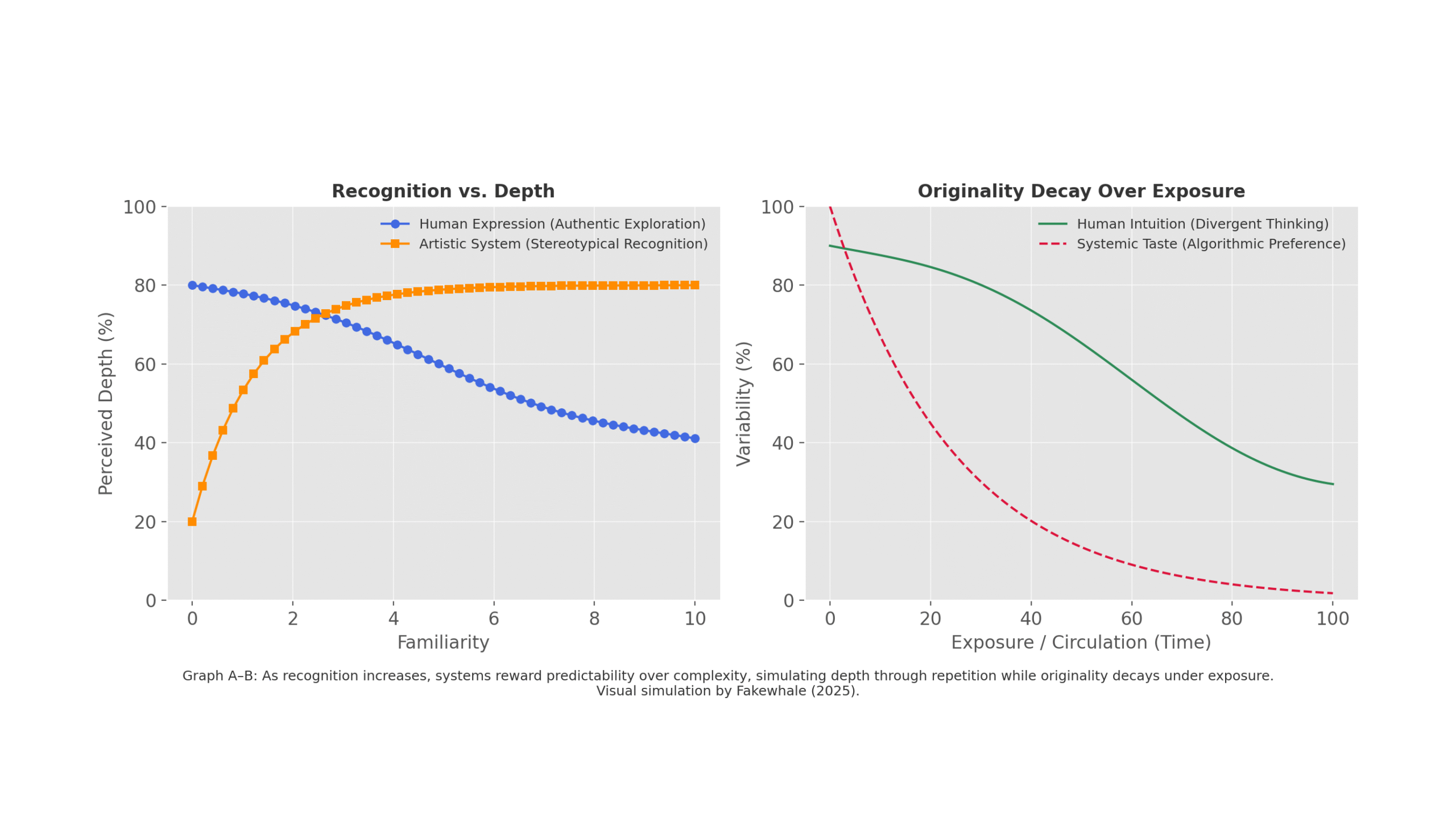
But there is another layer to this illusion, subtler and more deeply rooted. It concerns the way art exploits its own stereotypes, not as boundaries to overcome, but as guarantees of legitimacy. Marble, oil painting, conceptual video art, cryptic or excessively long performances: each medium carries with it a recognized code, a promise of authenticity that makes it immediately readable as “art.” Within this system of automatic recognition, the artist no longer needs to invent language, only to inhabit its clichés.
The artwork, then, no longer strives to say something, but to reassure: it confirms the expectations of its audience, its market, its theoretical context. And just like language models that repeat statistical structures to generate meaning, art too relies on shared patterns, reproducing familiarity as a form of thought. Here, the illusion becomes perfect: the gesture appears profound precisely because it is recognizable.
CORE · Members
Continue reading
This essay is part of CORE. Membership opens it in full, with every CORE essay, the Hypercast library and the Fakewhale AI Curator.