

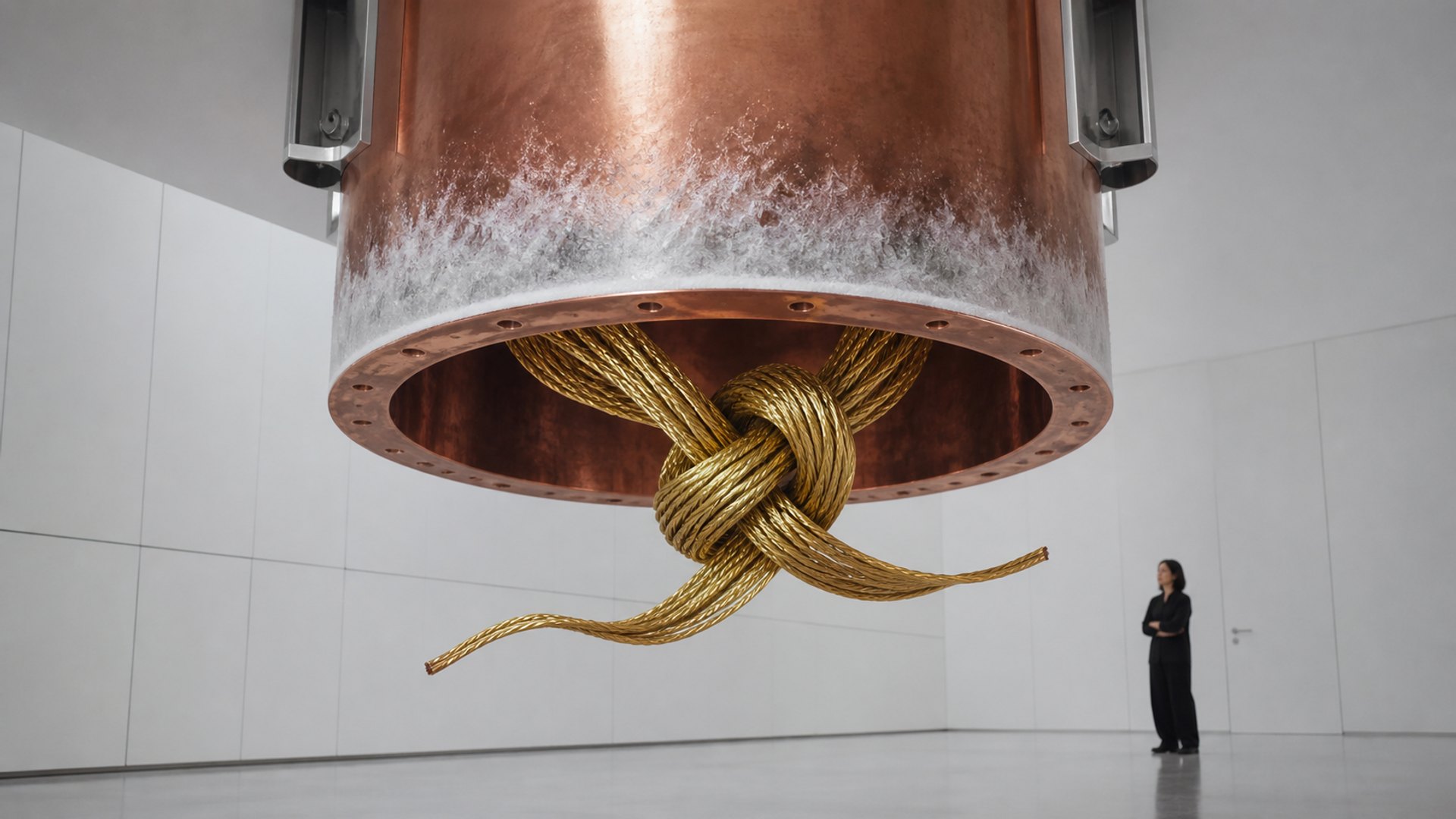
On a cooled chip, motion acquires custody. A quasiparticle circles another, the trajectory enters protocol, and memory settles into the relation between paths. The image of calculation shifts from inscription to choreography, from the brittle mark to the governed exchange, and the device begins to treat disturbance as a condition of address.
Topology gives error a jurisdiction. The local accident becomes an event routed through a global form, while information takes shelter in relations that exceed the point where noise arrives. A gate, here, names a political operation as much as a computational one: it decides which changes count, which fluctuations dissolve, which histories gain authority.
The laboratory image circulates as proof because distribution requires a figure of trust. Braids, lattices, entangled witnesses, and fidelity curves become the visual economy through which protected computation enters attention. The quantum device appears through diagrams that already understand platform logic, since visibility must be ranked, formatted, circulated, and converted into confidence before it becomes capital.
Matter learns secrecy through movement. The protected state has provenance, the error has custody, the gate has a market, and the future has a price assigned by survivability. Computation becomes less a sequence of commands than a topology of tolerated damage, a machine whose power begins where fragility becomes productive.
CORE · Members
Continue reading
This essay is part of CORE. Membership opens it in full, with every CORE essay, the Hypercast library and the Fakewhale AI Curator.


