


Years after visiting the 2013 Venice Biennale, a group of friends tried to reconstruct one of the works they had seen. What began as an ordinary conversation soon turned into a game of telephone. One remembered a structure occupying the centre of a dark room. Another insisted that it had been installed against a white wall. Someone recalled a mechanical sound; someone else could not remember any sound at all. The dimensions changed with each account. Elements migrated from one work to another, and details that initially seemed certain became less convincing each time they were repeated.
None of them was lying. Each was assembling the experience from a different set of surviving fragments: a material, a colour, the atmosphere of a room, the exhaustion of the day, the presence of the crowd, a conversation that had taken place nearby. They were not retrieving four incomplete copies of the same event. They were producing four different versions of it.
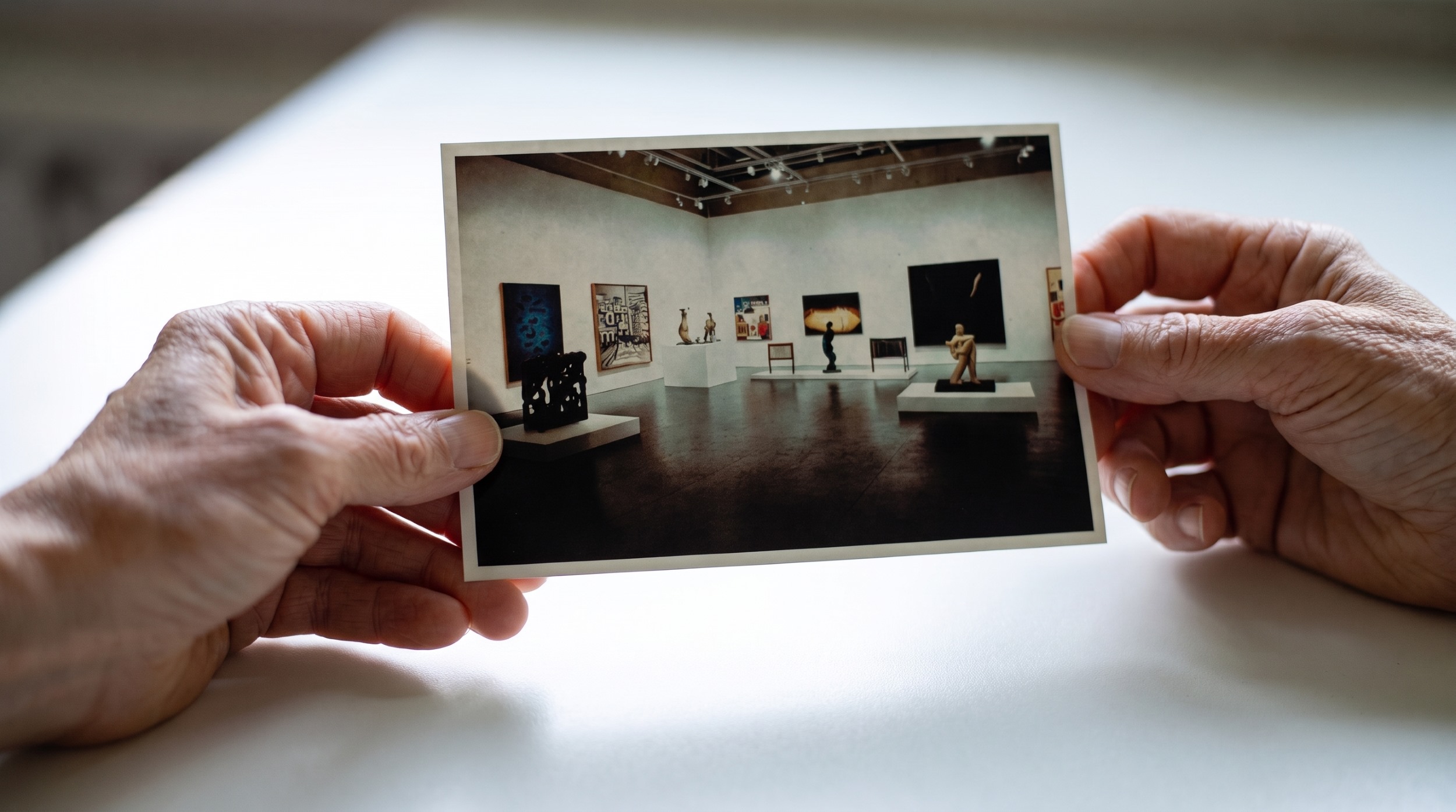
Eventually, one of them found a photograph on an old phone. For a moment, the disagreement appeared to be settled. The image seemed to provide evidence: this was what the work had looked like. Yet the photograph showed only part of the installation. Its upper edge was missing, one side was concealed by a passing visitor, and the frame gave no reliable sense of scale. Nothing remained of the sound, the route through the room, the surrounding works or the physical sensation of standing there.
The photograph corrected one detail while erasing several others. More importantly, once it had been seen, it began to reorganise the conversation. The friends gradually adjusted their memories to the image. Its partial version acquired more authority than their unstable recollections. What had begun as evidence of the experience was becoming the experience’s most convincing replacement.
This small episode opens onto a much larger question. What role does photography play in the memory of art? Does it preserve an encounter, interpret it, or gradually construct a new memory in place of the original one?
CORE · Members
Continue reading
This essay is part of CORE. Membership opens it in full, with every CORE essay, the Hypercast library and the Fakewhale AI Curator.


