



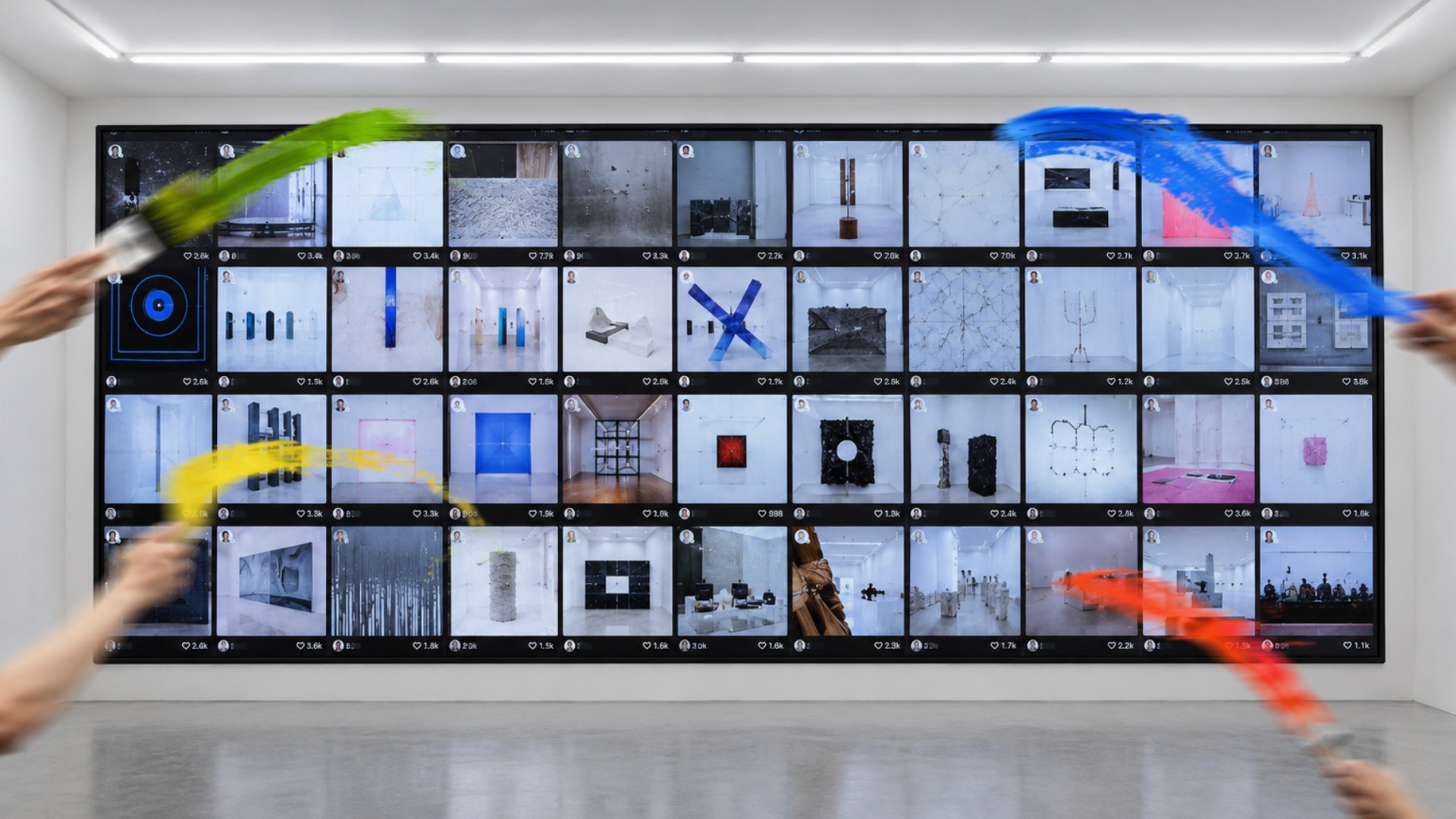
An expressionist work scrolls inside a feed. It is a digital painting, or the capture of a brushstroke, or an audiovisual fragment that pulses, and it reaches the screen after passing through a system that recognized it, labeled it, sorted it, and delivered it to a profile presumed to want it. Between the discharge that generated it and the eye that receives it, a layer has interposed itself that functions solely by rule.
We tend to imagine the digital as a container. A neutral space that hosts images, sounds, gestures, leaving their nature intact. Yet the digital, before it is space, is grammar. No content crosses it without passing through a syntax, a condition, a formalization that admits only what allows itself to be translated into logic.
Expressionism, across its history, claimed the exact opposite. It placed the mark as direct discharge, vibrational participation, a transfer of energy that precedes and overruns conceptualization. A mark that transmits more than it signifies, and transmits something deduction struggles to grasp.
From this friction comes the question running through this essay. If digital infrastructure exists solely through reason, and expressionism lives on a transfer that precedes reason, can that transfer still occur inside the network? Or is what we call digital expressionism only its image, the recognizable form emptied of the discharge?
We take no position. We seek to neither approve nor deny the possibility. We traverse the historical fracture that produced expressionism, the logical substrate holding up the digital, the nature of its transfer, the limit of algorithmic profiling, and we keep both scenarios open, the one in which the shiver is lost and the one in which it resurfaces, testing each to its end.
CORE · Members
Continue reading
This essay is part of CORE. Membership opens it in full, with every CORE essay, the Hypercast library and the Fakewhale AI Curator.


