

A video on YouTube lasts four seconds. A man in jeans and a white shirt stands with his arms at his sides. A marksman takes aim from five meters away. A shot. The man brings his hand to his left arm. End. Chris Burden, Shoot, 1971. Two hundred thousand views. Forty-two comments. The video moves through the feed with the same indifference as any other piece of content. Something in that indifference — in the ease of distribution, in the normalcy with which comments accumulate below — suggests we may have stopped understanding what we are looking at. Or perhaps we understand it better than the audience present that evening in Santa Monica. We do not know which of these is true.
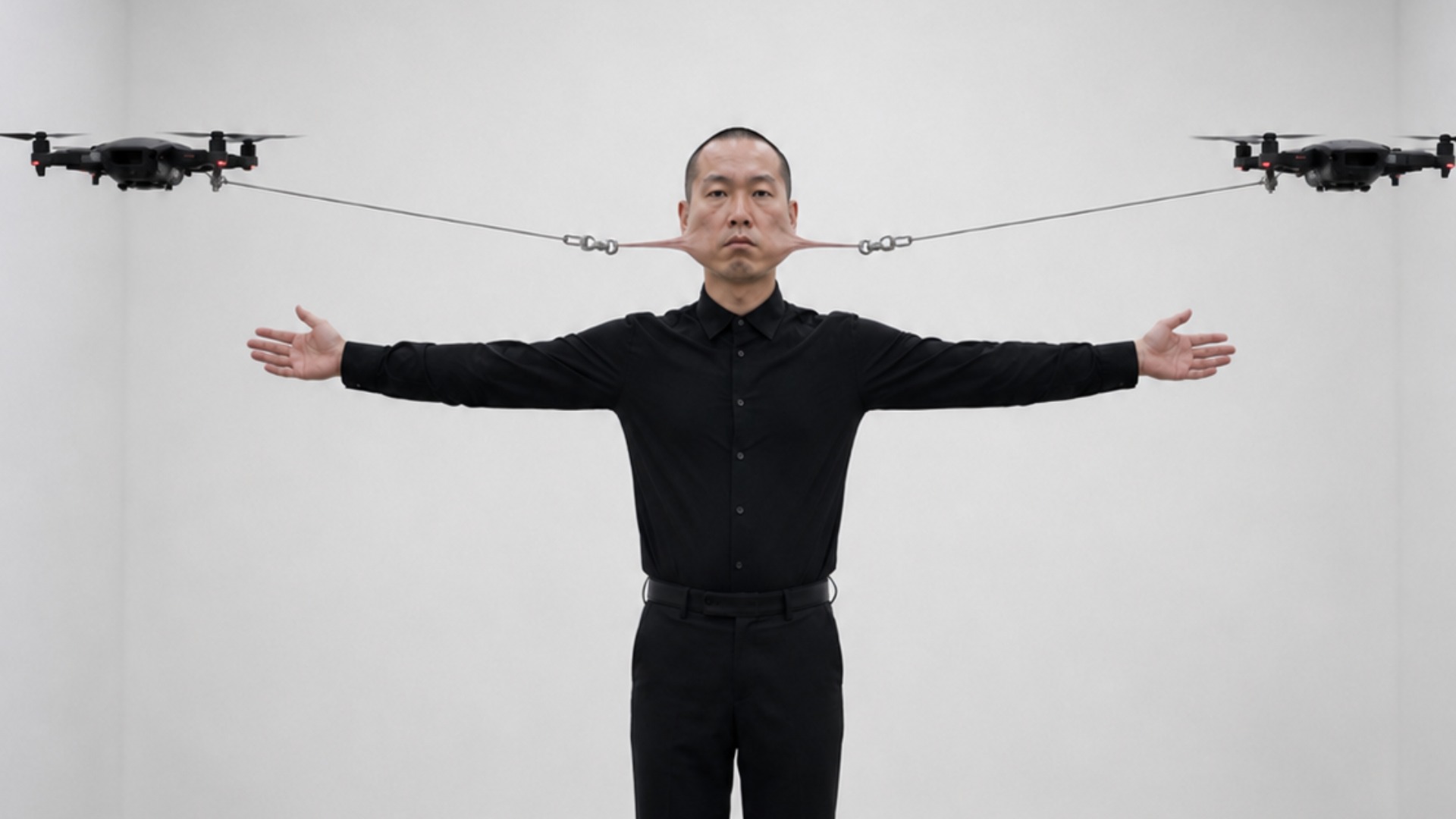
Performance art in the 1970s made a precise wager: the body as the irreducible. The wound as proof of presence. Pain as a document that cannot be falsified. The physical event as anti-institution, as excess relative to the art market, as territory where the system could not enter. It was an intelligent wager for that moment, for that system. The question we face now is whether the wager still holds: whether the body retains the force those artists attributed to it, or whether the system has learned to contain even this resistance, to distribute it, to value it as premium content in an attention economy hungry for authenticity.
We are unable to answer. This is not a limitation of this text; it is the point. The question admits no honest answer, and anyone who frames it with certainty in either direction is probably describing their own ideological comfort rather than the actual situation. What we can do is traverse the territory: the history, the structure, the internal paradoxes of the practice, the system that changed the conditions. We can arrive at the question with the greatest possible precision, without the consolation of a resolution.
The territory is layered. There is a historical genealogy: what the body did in the art of the 1970s, the structural logic animating those gestures, the problem they were trying to solve. There is a philosophical question: what we mean by body and sensory experience in the current moment, after decades of intensive mediation, after the haptic screen, after the enrollment of the body as network infrastructure. And there is a question that cuts across all of it, one that neither prior level resolves: whether the extreme gesture, the body placed at risk, presence as sole medium, retains the critical force it possessed in a radically different context.
We say this clearly before beginning: we are uncertain whether the body still matters. We are uncertain that it does not. This uncertainty is not indecision. It is the condition of anyone who examines the situation without the protection of a preformed thesis.
CORE · Members
Continue reading
This essay is part of CORE. Membership opens it in full, with every CORE essay, the Hypercast library and the Fakewhale AI Curator.


