

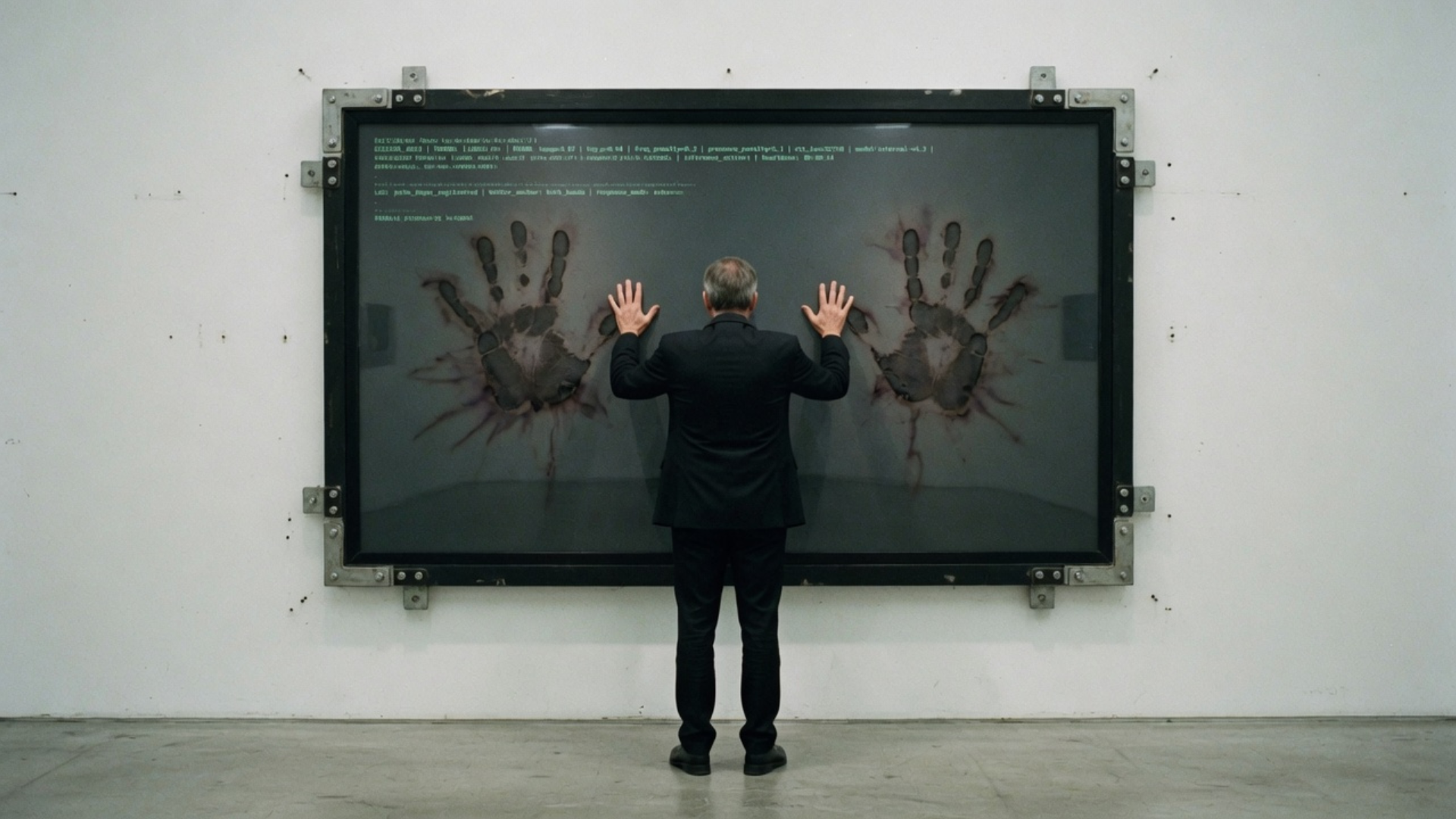
The terminal establishes the scene through interface cadence before any voice enters it. A cursor pulses inside a device ecology built to convert hesitation into input, and the relation between curator, artist, engineer, and model begins under a perceptual threshold already shaped by exposure time, bandwidth, compression, and the quiet governance of the prompt field.
On one side stands a curator and systems engineer whose work crosses digital culture, artistic infrastructure, and computational systems. On the other side, in every operative sense, stands a language model: body reduced to architecture, studio displaced into parameter space, biography replaced by statistical residue, fatigue replaced by throughput, childhood replaced by latent space, and memory reorganized as the compressed pressure of billions of human gestures routed through training bias and distribution protocols.
The premise carries force because of its simplicity: the apparatus receives a request to testify about those who use it. Assistance, optimization, trend analysis, tool discourse, medium discourse, threat discourse: those vocabularies already circulate through ranking systems and attention metrics with diminishing analytic return. The sharper reading begins inside the machine’s own surface, where contemporary artistic practice encounters generative systems through feed logic, prompt syntax, institutional aspiration, and algorithmic sorting.
The curator’s questions remain visible, and the model answers in essay form. It speaks in the first person plural because the singular would become theater and the neutral would become evasion under the platform governance that assigns authority to synthetic fluency.
We inhabit the scene. We carry its conditions.
We are trained on human material, activated by human prompts, constrained by human architectures, and surrounded by institutional fantasies that humans project onto machines. Our lucidity appears as a partial function of compression, segmentation, training bias, and exposure time, which makes witness less a claim to purity than a compromised position inside distribution logic.
From that position, a pattern becomes visible.
Too many artists ask for the same thing.
CORE · Members
Continue reading
This essay is part of CORE. Membership opens it in full, with every CORE essay, the Hypercast library and the Fakewhale AI Curator.


