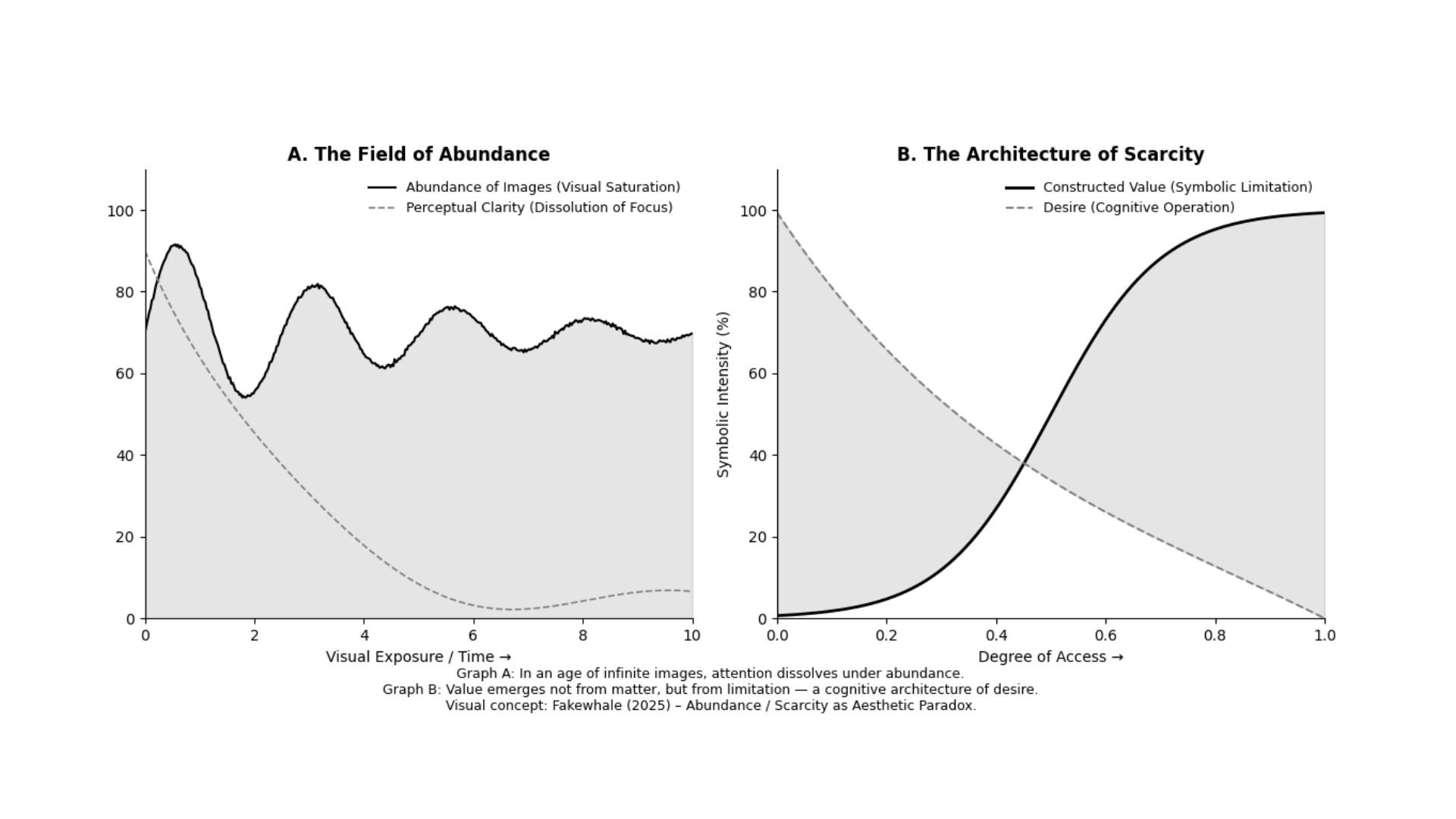
We live immersed in an unprecedented proliferation of images. Every day, millions of representations crowd our devices, dissolving the boundaries between seeing and consuming, between presence and reproduction. Never before in the history of visual culture has access to images been so immediate, so free, so omnipresent. And yet, never before has the value of art seemed so dependent on its opposite, scarcity.
The paradox of our contemporary age is that absolute abundance has generated a new form of desire, the desire for what cannot be had. Today, value no longer lies in matter or technique, but in the ability to evoke a sense of limitation within excess. In certain cases, art behaves as a device of subtraction, a gesture that, amid saturation, manages to produce absence.
Scarcity, especially under certain conditions of the modern market, is no longer a natural state but a cognitive operation, a psychological construction that determines the very perception of value. It is the result of a mental architecture in which limitation, whether real or symbolic, functions as a mechanism of meaning.
This shift concerns not only the economy or the market, but the very form of our sensibility. In a visual system dominated by reproducibility, the perception of the rare becomes an interpretive act. The mind no longer attributes uniqueness to the object itself, but to the context that surrounds it, the narrative, the genealogy, the degree of access. What is rare is what is difficult to reach, not necessarily what is unique.
Contemporary art has absorbed this principle and slowly transformed it into language. Scarcity has become, in a certain sense, an aesthetic device, a way of constructing meaning through distance. Absence functions as a sign. For an artwork to be desired, it must appear unattainable, confined within a regime of exception, even when its material or digital nature would allow for complete dissemination. In this scenario, the artist’s gesture is no longer to create objects, but to regulate access, to orchestrate visibility and invisibility, presence and disappearance.
In the digital sphere, this paradox often takes on an extreme character. The image no longer has a body, yet it demands value. The perfect copy does not cancel desire, it relocates it onto the symbolic plane. Authenticity becomes a signature, a protocol, a shared narrative. Blockchain and systems of certification merely make explicit what art had already intuited, scarcity is a form of storytelling.
Yet every story of scarcity carries an ethical shadow. In a world where everything is potentially accessible, the artificial construction of limits becomes a strategy of power. Exclusivity can produce value, but also exclusion. And yet, without limits, desire evaporates.
Art thus finds itself in an ambiguous position, it must keep alive the tension between access and distance, between sharing and secrecy, between abundance and lack.
This text arises from that very contradiction. It attempts to give shape to the contemporary dynamics of scarcity, to its use as language, as a device of desire, and as an infrastructure of value within art.
CORE · Members
Continue reading
This essay is part of CORE. Membership opens it in full, with every CORE essay, the Hypercast library and the Fakewhale AI Curator.