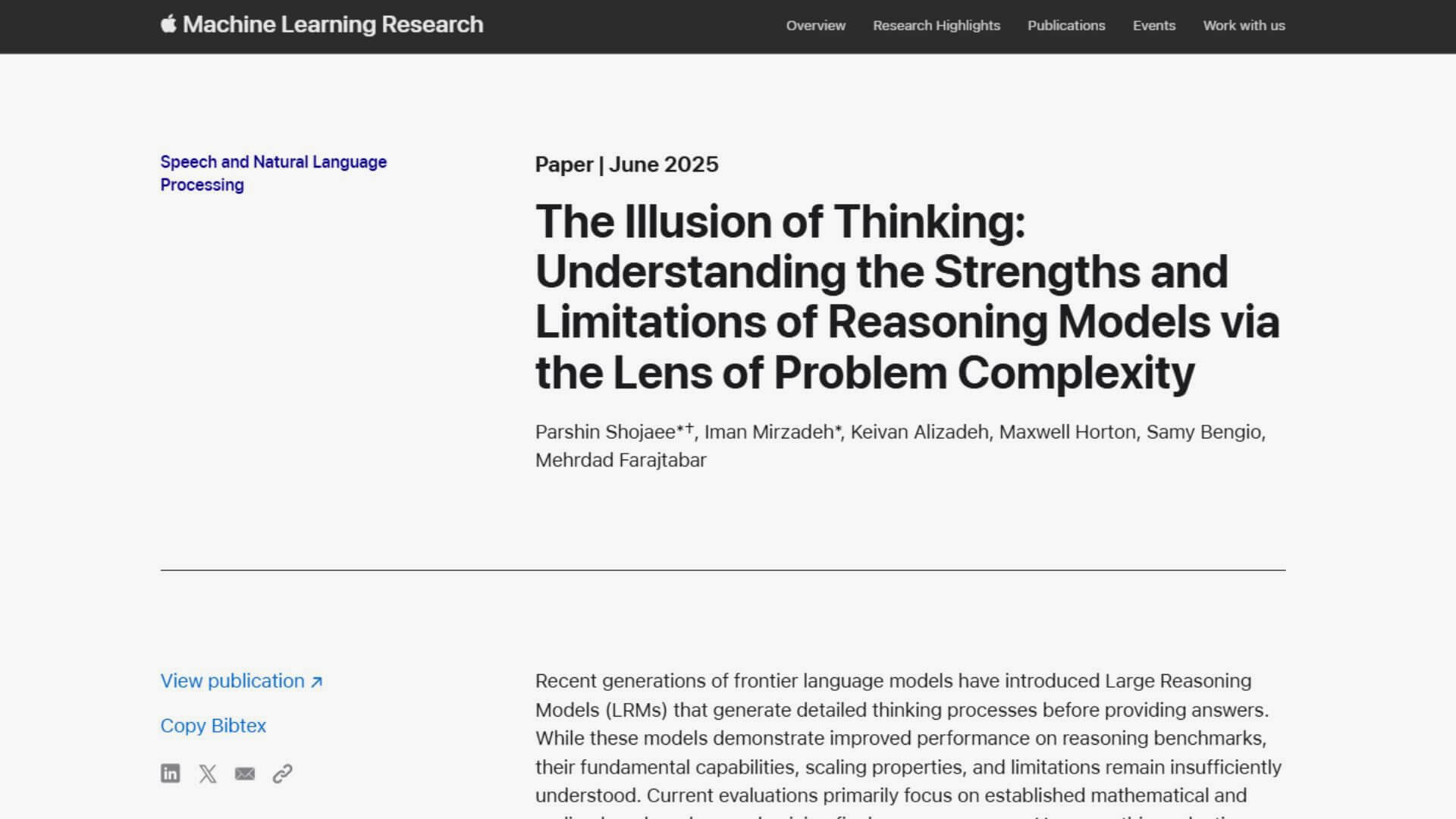
A few days ago, Apple released a paper titled The Illusion of Thinking, in which the authors argue, with notable methodological precision, that even the most advanced language models, including OpenAI’s o3, do not truly “think.” What actually happens, according to their findings, is a sophisticated emulation of logic: a highly optimized form of pattern matching that produces convincing answers, but only within familiar, predictable, or trained contexts. When problem complexity increases, as in the custom-designed reasoning puzzles Apple devised, even the most powerful models begin to collapse. Not due to a lack of data, but due to a structural inability to construct genuine cognitive pathways.
This is where the heart of the paper’s controversy lies: artificial intelligence does not fail because it is “undertrained,” but because its very architecture lacks the capacity to reason. It simulates, adapts, and selects the most plausible form, not out of understanding, but out of structural mimicry. What’s more, many of these models are engineered specifically to excel at benchmarks, optimizing for outcomes rather than comprehension. The result is a form of apparent competence, an illusion, precisely, that replicates the shape of reasoning while bypassing its substance.
In this assertion, we recognize something long felt, and increasingly unsettling, within the realm of contemporary art.
What would happen if we attempted to rewrite, structure by structure, this very paper, but replaced its subject, “AI,” with another: the “work of art”?
What would emerge, for instance, if we no longer thought of the artwork as an authentic expression, but as a system of progressive adaptation to a network of external constraints, galleries, platforms, visibility algorithms, taste-making dynamics, and curatorial efficiency?
Within this speculative experiment, each chapter of Apple’s paper becomes a conceptual lens through which we might examine the structural mechanics behind contemporary art-making, not as a critique, but as a mirror. We have not authored this text in the traditional sense. Rather, we have intervened in its architecture, exchanging the subject “AI” for “contemporary artwork,” allowing the original reasoning to unfold under different conditions of meaning.
What you are about to read should not be taken as a position, nor as a theoretical statement authored by us. This is not a manifesto. It is a literary ready-made, a gesture of displacement. A reappropriated analytical device used to trace points of collapse, thresholds of ambiguity, and moments of tension within the very logic of art production today. In adopting and reprogramming the original structure of the Apple paper, we aim not to parody it, but to perform a shift: from machine to artwork, from artificial intelligence to aesthetic simulation, from computation to curatorial conditioning.
If the reasoning still holds, or begins to fracture, under this new subject, that fracture is itself meaningful. What interests us is not consistency, but friction. Not the proof of a thesis, but the exposure of a system through the simple act of substitution.
We invite the reader to approach the following text as an artistic object in itself, one that operates in-between critique and fiction, fidelity and détournement. A displaced document, unfaithful by design. A theoretical experiment disguised as commentary, or perhaps the opposite.
For this reason, the full body of text below should be read as an artistic work, italicized in its entirety.
CORE · Members
Continue reading
This essay is part of CORE. Membership opens it in full, with every CORE essay, the Hypercast library and the Fakewhale AI Curator.