



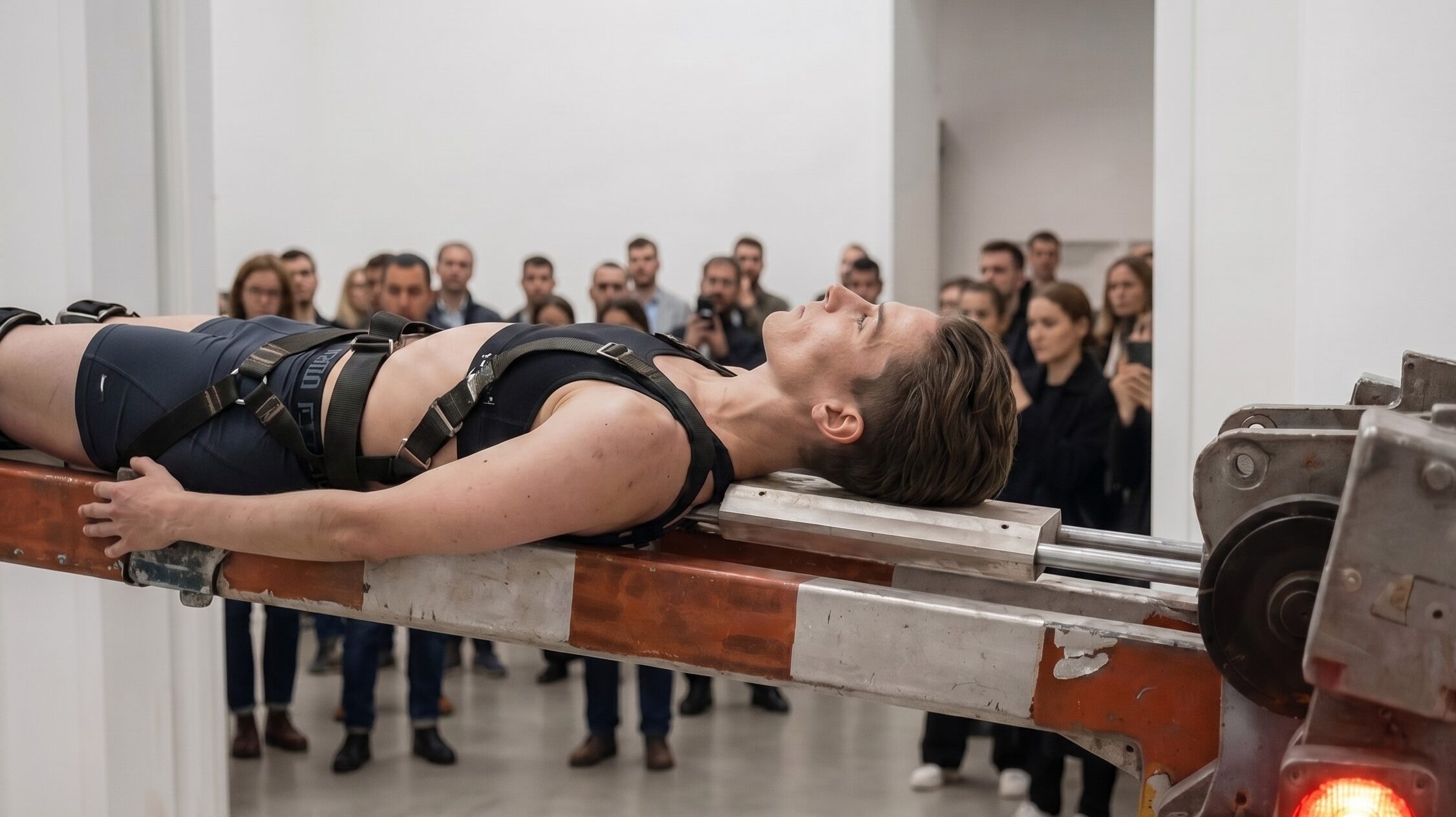
Recently, while looking online at images from a major international biennial, we noticed something fairly revealing: the works attracting the most attention were not necessarily the most complex or conceptually rigorous, but the most spectacular and entertaining. The ones visitors could physically enter, lie inside, play with, walk through, photograph, or experience through unusual performances. Monumental installations dominated by intense colors, predictable soundscapes, and immersive dynamics designed less to provoke reflection than to deliver temporary sensory entertainment.
From this observation, a more complex question began to emerge: at the moment when artworks are increasingly designed to capture attention instantly, to be walked through, photographed, shared, and visually consumed within seconds, is contemporary art in major biennials gradually adopting the logic of entertainment itself?
Not in the superficial sense of the term, but in the very structure through which these works are conceived. More and more projects seem engineered to generate immediate engagement, provoke a physical response, and create the perfect moment for online circulation. The artwork no longer asks for time, silence, or interpretation; it has to function immediately. It has to impress. It has to be immersive, experiential, and above all socially shareable, a condition that inevitably connects to one of the central themes we have been investigating for years.
Moving through pavilions, renderings, and installation videos, the impression often feels less like encountering spaces of critical artistic inquiry and more like entering a highly curated form of cultural entertainment, where the boundaries between artistic research, immersive scenography, and spectacular attraction become increasingly difficult to distinguish. And perhaps the issue is not even that art has become more accessible or participatory. The real question is what gets lost when everything must be instantly engaging, instantly legible, instantly consumable, and now increasingly designed specifically for social media visibility.
We have already explored this subject before, yet the reflections surrounding it never seem exhausted. More and more frequently, artworks appear to exist not to be contemplated or decoded, but to be rapidly experienced, photographed, and shared. And within this obsession with continuous engagement, difficulty, ambiguity, and even discomfort, elements that for decades formed the core of artistic research, are progressively neutralized in favor of a form of cultural entertainment perfectly aligned with the logic of social media, creative tourism, and the attention economy.
CORE · Members
Continue reading
This essay is part of CORE. Membership opens it in full, with every CORE essay, the Hypercast library and the Fakewhale AI Curator.


