

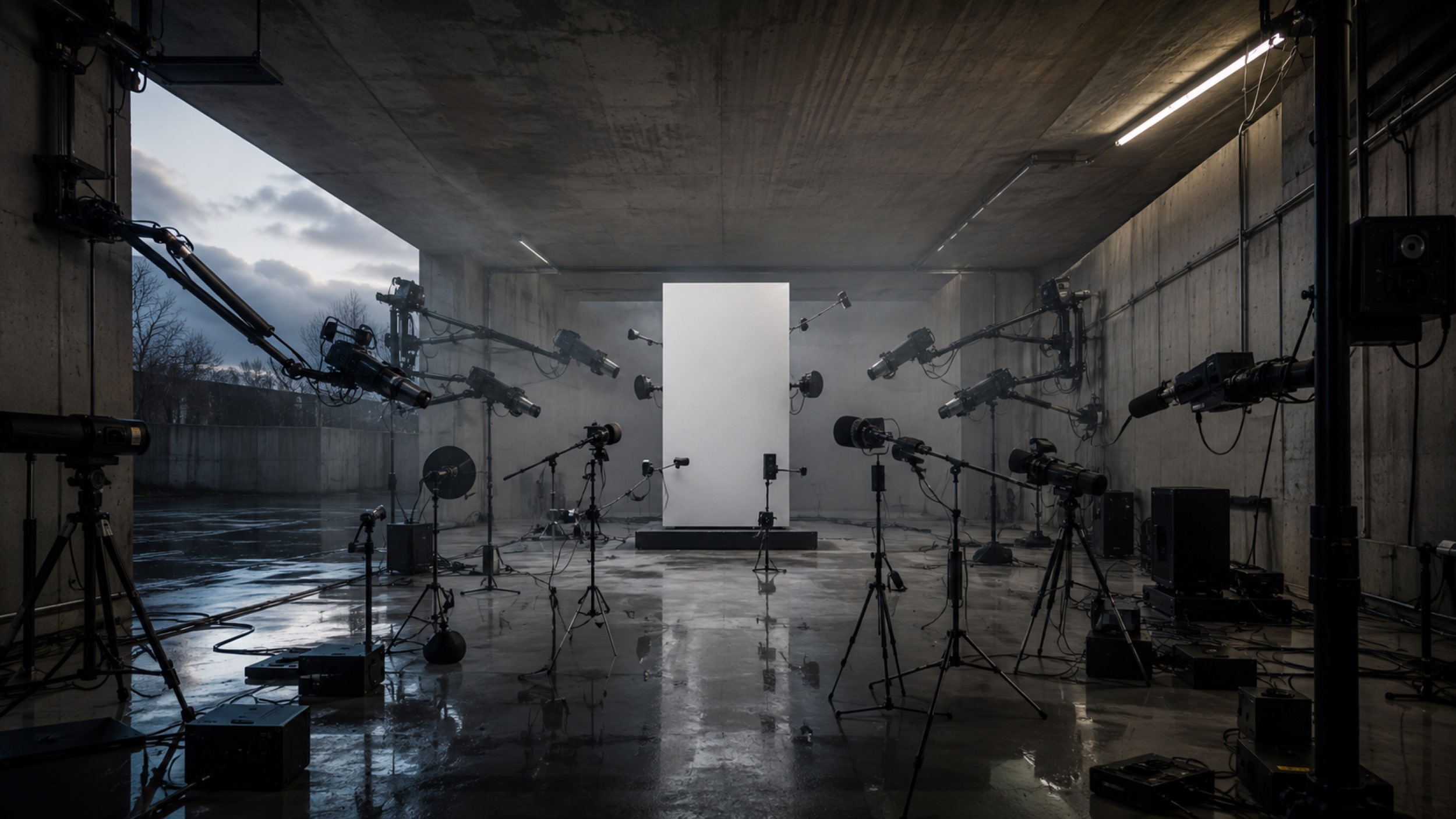
A signed urinal, a canvas painted almost uniformly black, four minutes and thirty-three seconds of silence, a block of ice pushed through a city for nine hours until it vanished. Attempts spread across a century, each aiming at the same impossible feat: a work that means nothing. All of them failed, and failed in the loudest possible way, because each gesture became one of the most discussed, most interpreted, most meaning-laden objects in the history of art. Whoever went looking for silence produced the most lasting noise.
The paradox holds exactly, with no way around it. In art, the attempt to say nothing is the thing that says the most, and the will to empty a work fills it to the brim. Every time an artist declared the intention to eliminate meaning, taste, emotion, narrative, the world answered with libraries of interpretation, and the emptied object was refilled by other hands, with a punctuality that starts to resemble a law.
This text does not narrate those attempts, it moves through them toward what they reveal. Its real subject is the paradox itself, taken at the root, where it touches the nature of language. Because visual art, before it is expression, market, or institution, is a language: a system of signs circulating between whoever produces them and whoever receives them. And if it is a language, then the meaningless work is its impossible utterance, the sentence that would rather not be a sentence, the word spoken with the intention of saying nothing.
The question in the title deserves to be taken literally, the way a thought experiment deserves to be taken seriously. Can a work of art mean nothing? What exactly would have to happen for an exhibited object to say nothing to anyone? And if this proves impossible, as we suspect, what does that impossibility tell us about the nature of art, of the sign, of the gaze that meets it. The short answer is that silence, for a language, is not a possibility: it is only another word. The long answer occupies the pages that follow.
CORE · Members
Continue reading
This essay is part of CORE. Membership opens it in full, with every CORE essay, the Hypercast library and the Fakewhale AI Curator.


