

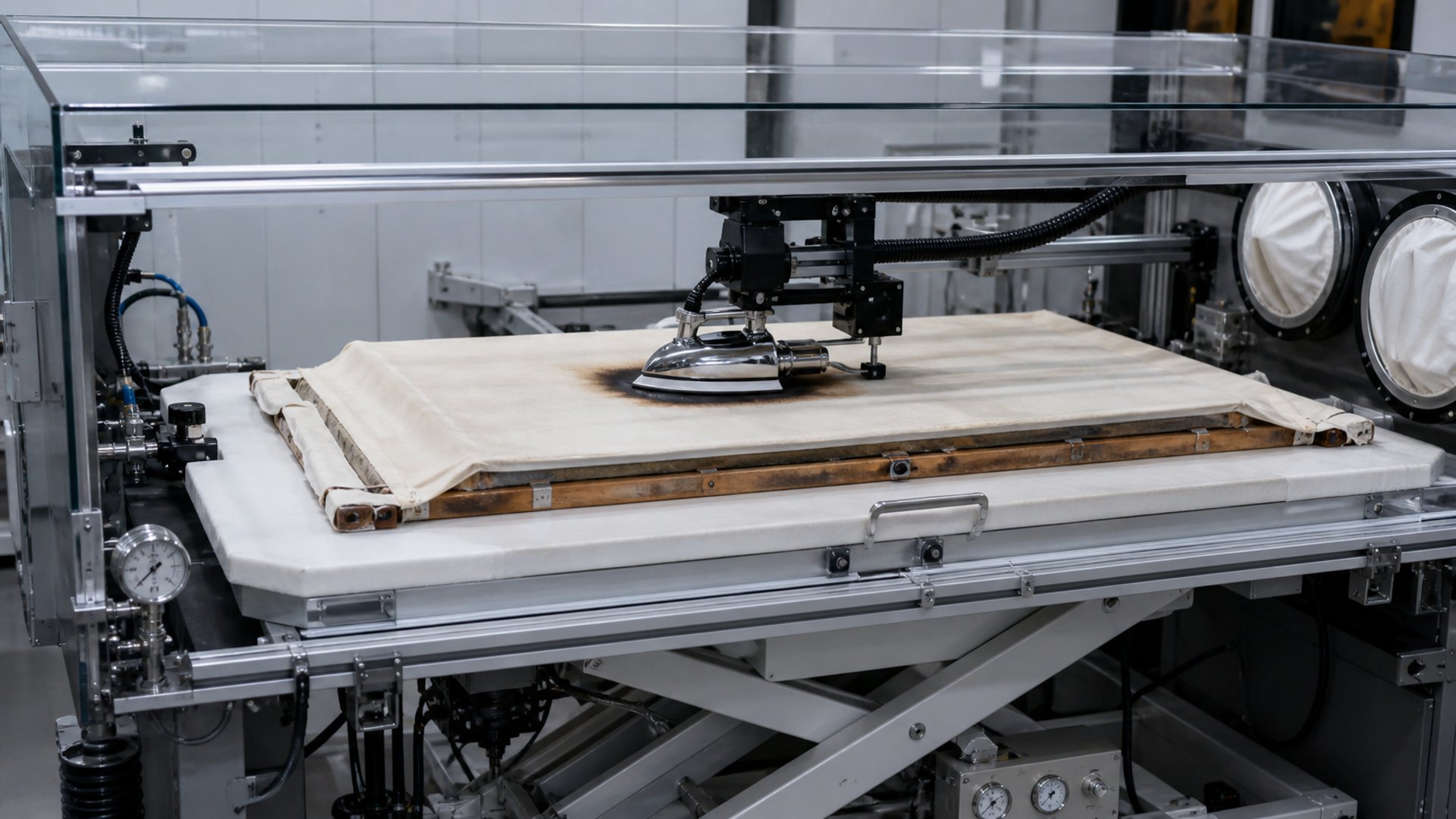
A Rembrandt lies face down across an ironing board. Linen covers linen, the hot plate advances, and the arm applies domestic pressure to a surface whose custody ordinarily requires gloves, climate control, and institutional permission. The scene condenses a jurisdictional conflict. Painting enters use, use enters provenance, and an appliance redirects the protocols through which an image receives artistic status.
The reciprocal readymade operates as a conversion device. The familiar readymade raises a commodity through nomination, placement, and attention; its reciprocal form directs consecrated matter toward ordinary function. This downward passage reveals the mobility of rank. Artistic status persists through coordinated acts of framing, cataloging, circulation, ownership, and recognition, each act stabilizing the object inside a distribution system that presents its own decisions as inherent value.
The ironing board also anticipates the platform condition of the image. Ranking systems continuously elevate and demote cultural material through visibility, repetition, and metadata, while latent space renders every image available for recombination. A Rembrandt circulates as masterpiece, file, training sample, meme, auction asset, and decorative background. Each appearance carries a different protocol of use, yet institutional and economic systems keep returning these versions to a privileged source.
Reciprocity therefore concerns authority over passage. The decisive question gathers around the hand entitled to move an object between art and equipment, image and surface, patrimony and material. Reversibility appears formally simple and politically dense. A change of use activates ownership, conservation, insurance, law, and public expectation; the gesture that restores thinghood also exposes the apparatus that had suspended it.
CORE · Members
Continue reading
This essay is part of CORE. Membership opens it in full, with every CORE essay, the Hypercast library and the Fakewhale AI Curator.