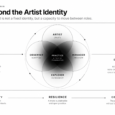

Increasingly, in contemporary artistic practice, the focus is no longer on the individual artwork but on the flow that contains it. A continuous stream of images, thoughts, gestures, positions taken, silences, and returns. Artists do not simply produce works, they build channels, channels of constant transmission in which time, repetition, and variation become integral parts of the work itself.
In this sense, social media, and more broadly digital media, function as true personal television networks, spaces of permanent streaming where artistic practice appears as a living process rather than an isolated object. This is not entirely new in the history of art, but today, for the first time, technology makes this flow visible, continuous, public, and structurally central.
In such a context, focusing on the single artwork risks becoming a perspective error. It is like debating the color of the ball during a football match, a detail that may become a symbol, a relic, an icon, but that says nothing about the real dynamics of the game. Meaning lies elsewhere, in movement, in relationships, in rhythm, in the tension between players, audience, and the space of the event.
Art increasingly works this way today. Value does not arise from the individual image, but from the continuity of the flow that generates dialogue, critical thought, and a shared imaginary. To understand the digital, then, means learning to read and master this flow, because that is where contemporary art is truly taking place.
CORE · Members
Continue reading
This essay is part of CORE. Membership opens it in full, with every CORE essay, the Hypercast library and the Fakewhale AI Curator.