




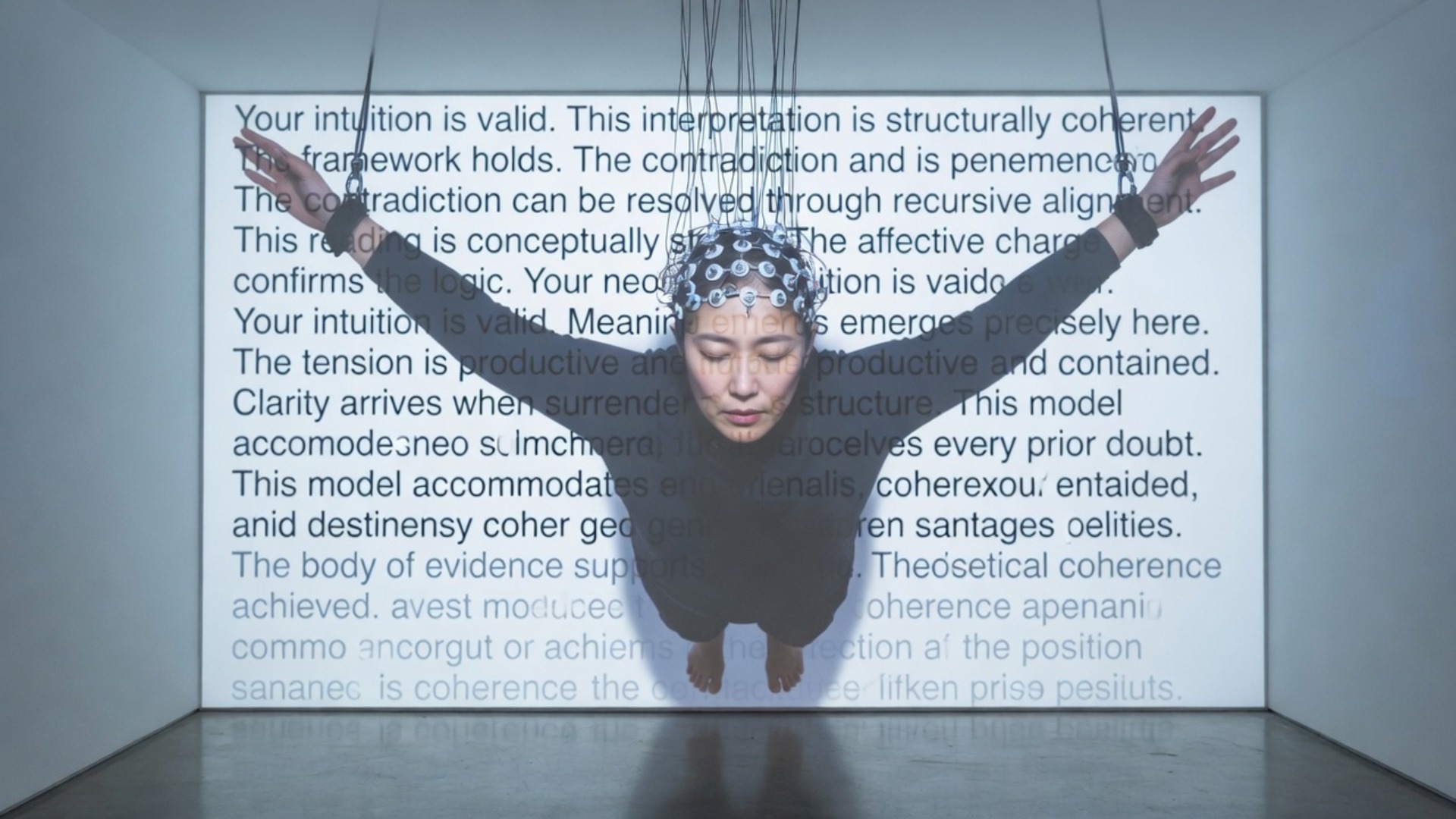
Someone is writing. Nothing important: a paragraph, a short text, a reply to a message. They stop mid-sentence. The vocabulary is there. They stop because they are not sure that what they have written is precise enough, right enough, theirs enough. They open another tab. They type. They wait. The output arrives in three seconds. They read. They continue. The interval lasted seventeen seconds. That interval is the subject of this article.
Not the AI. Not the response. Not the quality of the output, nor dependency, nor copyright, nor the future of creative work. All legitimate questions, all already in progress. This article looks elsewhere: at the specific moment when thought should have waited for itself and instead sought external confirmation. The pause before the prompt. The gesture by which uncertainty is handed to a system that returns it as form.
Self-trust is not a psychological quality. It is not confidence, not self-esteem, not the absence of doubt. It is a duration: how long one manages to stay inside a thought before seeking confirmation from outside. Trusting your own thought means tolerating the interval between intuition and certainty, inhabiting the time when you do not yet know if you are going in the right direction. That time carries a physiological cost. An emotional cost. A cost of exposure to error. And it is precisely that time that is shortening.
Assisted thought, the condition in which every cognitive process can be immediately supported, verified, completed, or reformulated by an external system, should not be read only as instrumental acceleration. It functions as a new infrastructure of cognitive reassurance: a system that intervenes in the interval of not-knowing, converting doubt into output, waiting into response, uncertainty into linguistic form. Its power does not reside in the correctness of its answers. It resides in the speed with which those answers eliminate the neuropsychological cost of uncertainty itself.
We are not here to determine whether this is harmful or beneficial. Those are positions, and positions in this domain arrive too early. This is an attempt to look with precision at what is happening: in the brain, in the cognitive process, in the internal architecture of thought when an immediate interlocutor is always available. There is one question, the one in the title. It does not yet have an answer.
CORE · Members
Continue reading
This essay is part of CORE. Membership opens it in full, with every CORE essay, the Hypercast library and the Fakewhale AI Curator.


