



There is a page in this year’s forecasting reports where the word friction appears as a catalogue entry. Beside it, in an ordered column: grain, texture, glitch, nostalgia. Each entry carries its recommended palette, its swatch library, its estimated adoption window. These are the terms through which design culture names its reaction to generative smoothness, the authorless polish that has saturated the visual surfaces of platforms, campaigns, and interfaces over the past several years.
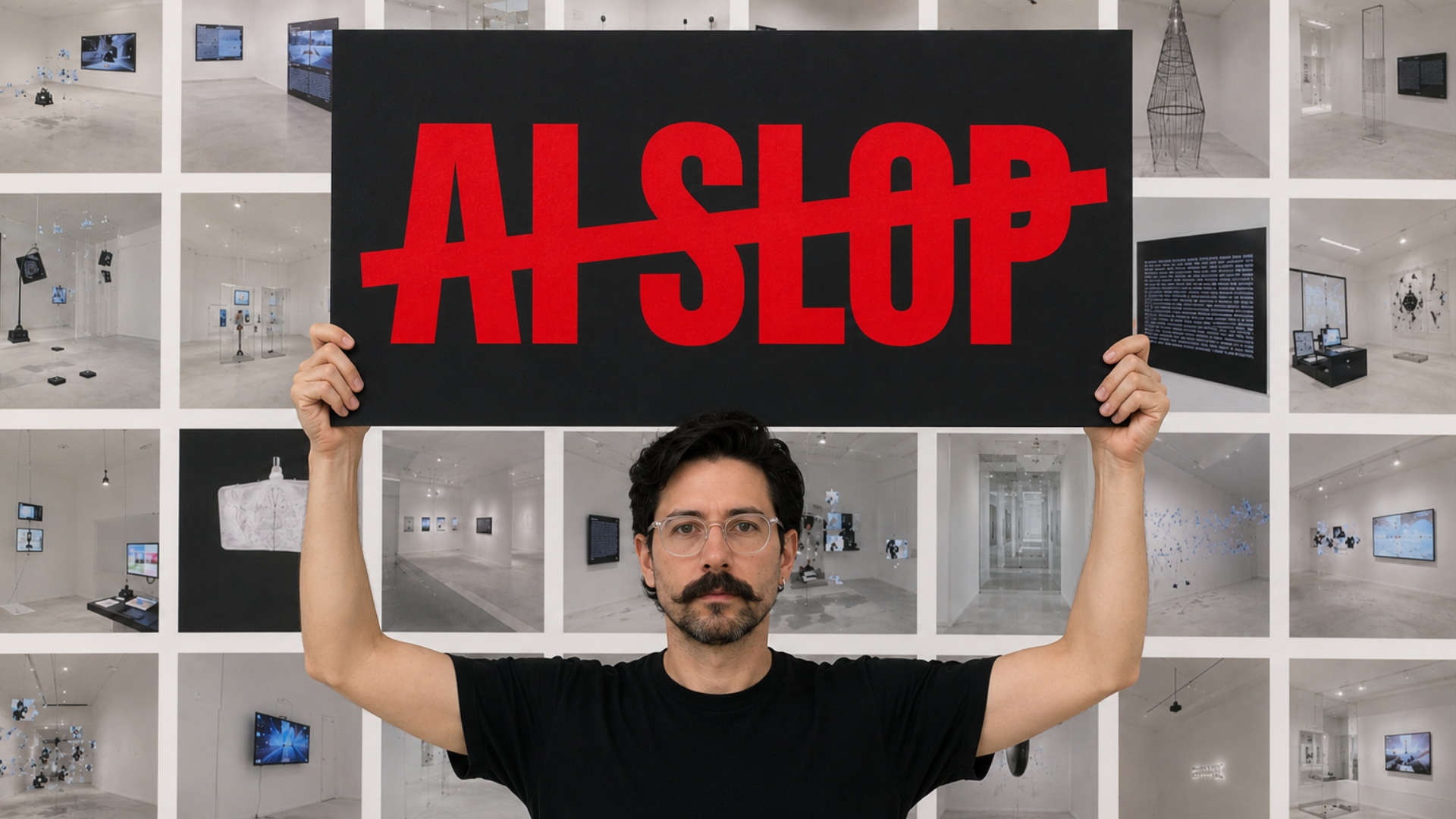
The reaction already has a working name: anti-slop. Designers reintroduce the defect, creative directions commission certifiable imperfection, and a diffuse demand emerges for forms that carry proof of a real process. So far this follows a familiar arc, since every wave of automation in the history of the applied arts has produced a corresponding return of the hand. The decisive fact lies elsewhere: in the location of the phenomenon.
Anti-slop surfaces inside the document that predicts it. Earlier counter-aesthetics emerged from basements, self-published magazines, margins the market would discover late; this one arrives to its public already paginated as an annual trend, complete with color codes and duration estimates. The revolt against the machine was scheduled before it was observed.
This essay suspends every verdict of sincerity or calculation and follows a larger condition, one that concerns anyone producing form today. The cycle that historically absorbed counter-aesthetics, a cycle that once took decades, then years, then months, has reached negative latency. Capture precedes emergence. What the avant-gardes called recuperation has become anticipation, and our interest lies in how the mechanism works, where it comes from, and what it leaves intact.
CORE · Members
Continue reading
This essay is part of CORE. Membership opens it in full, with every CORE essay, the Hypercast library and the Fakewhale AI Curator.


