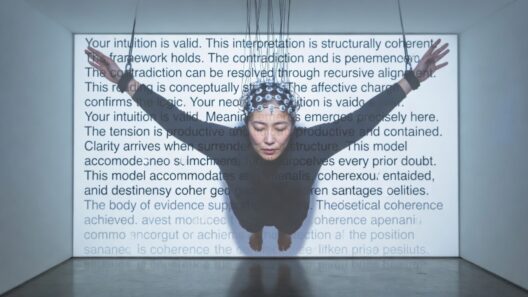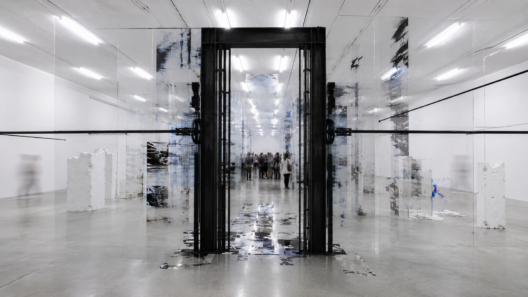
Contemporary art rarely appears naked. It arrives already introduced, photographed, described, installed, laid out, shared, compressed into a format, protected by a narrative, filtered through a sequence of images, accompanied by a visual grammar that prepares the encounter in advance. Before it becomes matter, it becomes access. Before it becomes experience, it becomes interface. Before it is judged as a work of art, it is often recognized as the image of a work of art.
This shift, especially today, radically alters the way we look. We no longer encounter only installations or paintings; we encounter systems of presentation that organize the conditions of perception before the work even appears. We have addressed this issue before, but this time we wanted to go deeper, offering a second reflection on the framing effect, a theme that remains particularly close to us and continues to fascinate us.
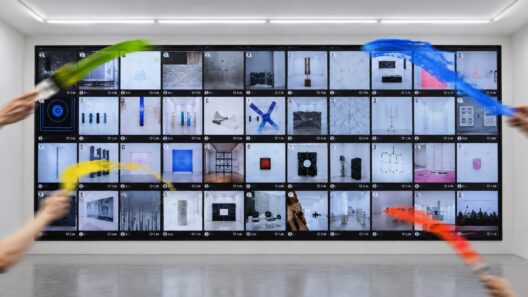
We all know that an exhibition does not circulate only through the physical space in which it takes place. It circulates through the photographs that make it visible, the texts that stabilize it, the website that archives it, the caption that makes it shareable, the press release that places it within a genealogy, and the design that produces its authority. An exhibition is, after all, an event, and as such, it must be communicated, documented, and recorded.
Remember the old opposition between content and packaging? Here, we are already beyond it. That opposition held as long as we could imagine presentation as a surface applied afterwards, as a secondary layer, as an external apparatus added to the substance of the work. Today, that distinction has become far more unstable. The container, in its new 2.0 form, does not simply host the content. It makes it legible, directs it, measures it, and translates it into a regime of attention. At times, it amplifies the work. At times, it betrays it. At times, it produces the work as a cultural event before the work itself has any chance to resist that production.
A grainy photograph, a shaky video, poor documentation, a badly built webpage, or a weak narrative do not necessarily diminish the work in its material existence. A work does not become less complex simply because it has been badly photographed. Its structure, its intelligence, and its internal tension do not automatically disappear within a poor image. And yet, its reception changes. The threshold of access is lowered or closed altogether. The work may remain intact, yet arrive wounded.
We must therefore observe the point at which presentation ceases to be a service and becomes a condition. Not in order to passively accept the dominance of packaging, nor to defend a purity of the artwork that is now difficult to sustain. The issue is more precise: to understand how contemporary art can communicate its own image without being reduced to the codes that make it recognizable. Because the art system does not impose only values. It also imposes ways of seeing.
CORE · Members
Continue reading
This essay is part of CORE. Membership opens it in full, with every CORE essay, the Hypercast library and the Fakewhale AI Curator.